
Synthetic Bone Graft Substitute
Synthetic Scaffold. Deliberate Resorption.
Bi-Ostetic combines porous hydroxyapatite and tricalcium-phosphate granules within a collagen matrix strip to provide a conformable synthetic scaffold for clinician-directed bone-grafting procedures.
- Synthetic bone graft
- Hydroxyapatite and TCP
- Porous ceramic granules
- Collagen matrix strip
- Osteoconductive scaffold
- Five listed volumes
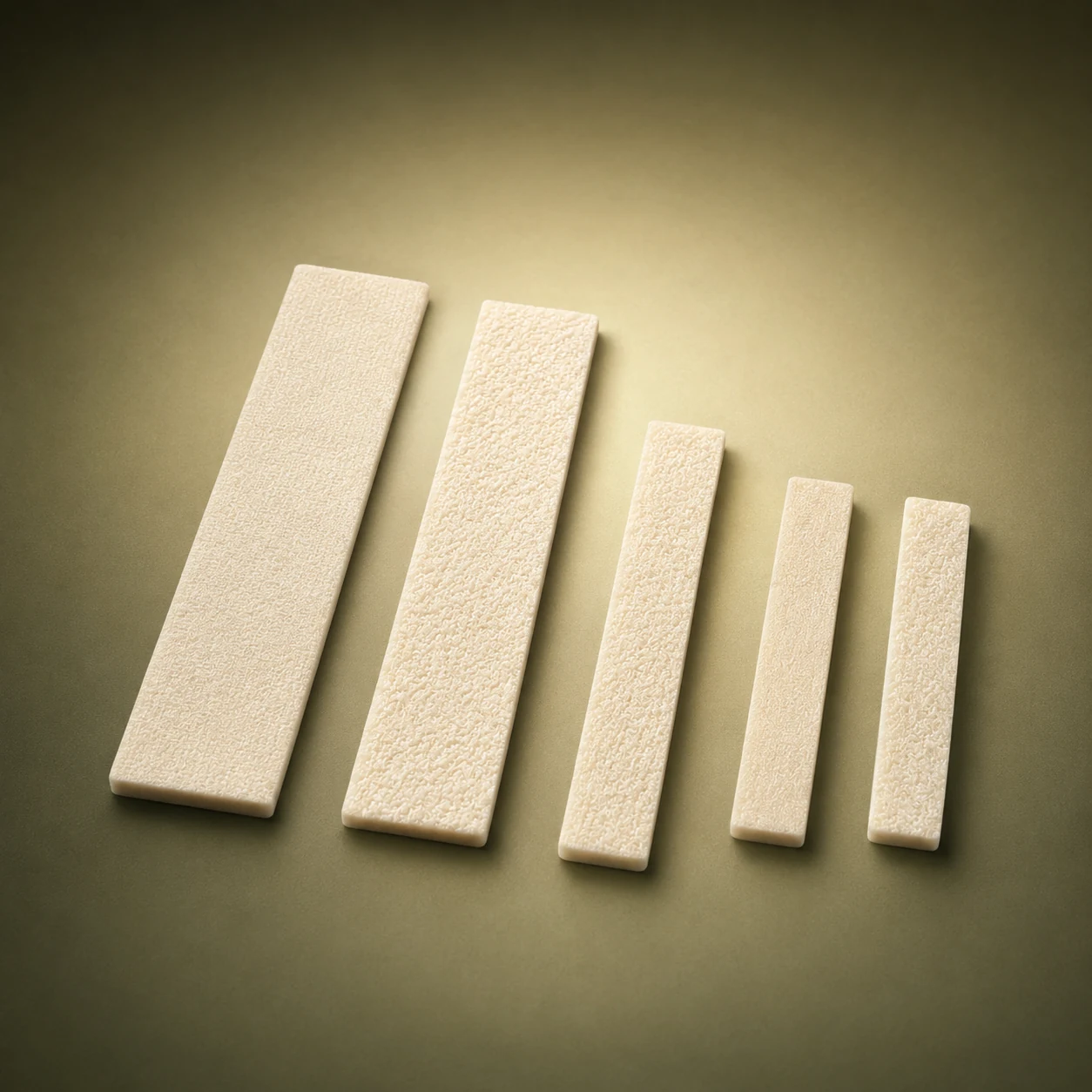
A biphasic ceramic scaffold in a manageable strip
Bi-Ostetic combines porous hydroxyapatite and tricalcium phosphate within a collagen matrix strip.
The two ceramic phases provide an osteoconductive physical scaffold with different resorption characteristics.
Incorporating the granules into collagen creates a contained graft form that can be handled and positioned more deliberately than loose granules alone, consistent with the current product labeling.
- Material
- Hydroxyapatite and tricalcium phosphate
- Carrier
- Collagen matrix
- Configuration
- Ceramic granules in a strip
- Workbook volumes
- 1 cc through 15 cc
Two ceramic phases. One scaffold strategy.
Supplied product information describes hydroxyapatite and tricalcium phosphate as contributing different material characteristics within a porous, collagen-contained graft form.
Hydroxyapatite
Supplied product information describes HA as the more slowly resorbing ceramic component within the scaffold.
Tricalcium phosphate
Supplied product information describes TCP as the comparatively more resorbable ceramic component.
Porous architecture
The supplied product brief describes porous granules intended to support fluid penetration and cellular migration.
Collagen matrix
The surrounding collagen contains the granules in a strip that can be positioned within a prepared site.
Select the graft by required volume
Five synthetic-granule collagen-matrix strip configurations support a range of graft-volume requirements.
| SKU | Volume |
|---|---|
| EBF1-50X10-01 | 1 cc |
| EBF2-50X10-02 | 2 cc |
| EBF2-50X10-05 | 5 cc |
| EBF1-100x25-10 | 10 cc |
| EBF1-100x25-15 | 15 cc |
A contained alternative to loose ceramic granules
Always follow the current device labeling, Instructions for Use, institutional protocol and aseptic technique.
- 01
Inspect
Confirm the selected volume, product identity, package integrity and expiration information.
- 02
Open
Transfer the product to the sterile field using aseptic technique.
- 03
Prepare
Hydrate, combine or otherwise prepare the graft only as directed by the current Instructions for Use.
- 04
Shape
Contour the collagen matrix strip to the prepared site only when permitted by the labeling.
- 05
Place
Position the graft within the prepared site according to clinician technique and the current labeling.
- 06
Document
Record the product and procedural information required by the facility and product labeling.
Synthetic graft material for varied orthopedic environments
Bi-Ostetic may be considered where a qualified healthcare professional determines that a synthetic osteoconductive graft material is appropriate and consistent with its current labeling.
- Spine
- Trauma and extremities
- Foot and ankle
- Hand surgery
- Joint reconstruction
- Hip revision
- Non-structural bone-void filling
These procedure categories are navigational. They do not expand the product's labeled indications or imply a particular clinical result or recommendation.
Common Bi-Ostetic questions
What is Bi-Ostetic made from?
Bi-Ostetic contains porous hydroxyapatite and tricalcium-phosphate ceramic granules within a collagen matrix.
Is Bi-Ostetic human tissue?
No. Bi-Ostetic is a synthetic bone graft product and is not a human tissue allograft.
What does osteoconductive mean?
An osteoconductive material provides a physical scaffold along which new bone may grow. It does not independently supply living cells.
Why combine HA and TCP?
HA and TCP have different resorption characteristics. Their combination provides a biphasic ceramic scaffold with component-specific resorption.
Is Bi-Ostetic supplied as loose granules?
The current Evologics portfolio lists the synthetic granules in a collagen matrix strip.
What volumes are available?
Bi-Ostetic is offered in 1 cc, 2 cc, 5 cc, 10 cc and 15 cc configurations.
A medical device with product-specific labeling
Bi-Ostetic is a synthetic bone graft product intended for use by qualified healthcare professionals according to its current labeling, Instructions for Use, institutional protocol and clinician judgment.
Current controlled labeling governs the exact indications, materials, contraindications, warnings, preparation and storage requirements.
Website content does not imply that the product is load-bearing, independently osteogenic or clinically superior to another graft material.
Request the current Instructions for Use and device documentation from Evologics.
Bi-Ostetic
Request Bi-Ostetic information for your facility.
Connect with Evologics for current labeling, available volumes, product specifications, value-analysis materials and ordering information.